Article
Court Process Overview
Divorce Process
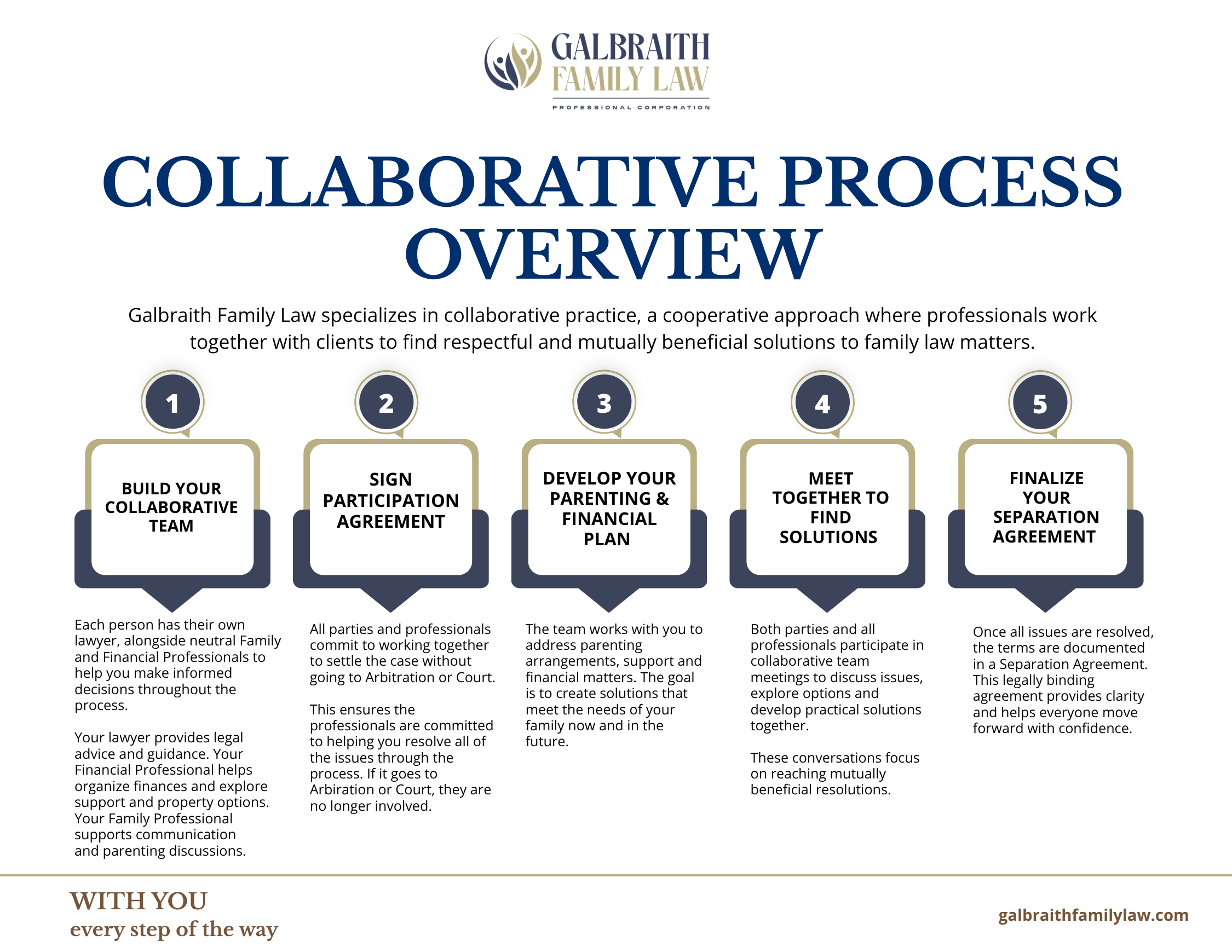
At Galbraith Family Law, we specialize in collaborative family law, a cooperative approach that helps separating couples resolve family law issues without going to court. Through open communication, professional guidance, and a commitment to problem-solving, the collaborative process allows families to reach practical solutions while reducing conflict and stress.
The collaborative process focuses on working together to create agreements that meet the needs of everyone involved, especially children, while preserving important family relationships.
Every participant has their own lawyer and may also work with neutral Family Professionals and Financial Professionals throughout the process.
Provides legal advice and guidance
Protects your interests throughout the process
Supports communication between the parties
Assists with parenting discussions and family dynamics
Helps organize financial information
Explores support and property options
Assists with financial decision-making
Together, these professionals help you make informed decisions and move through the process with confidence.
One of the foundations of collaborative practice is a shared commitment to resolving the matter outside of court.
All parties and professionals sign a Participation Agreement confirming their intention to work together constructively toward a settlement. This agreement includes a commitment that, if the matter proceeds to arbitration or court, the collaborative professionals will no longer be involved.
This encourages everyone to stay focused on finding mutually beneficial solutions.
The collaborative team works together to address the issues that matter most to your family. These discussions may include:
Parenting arrangements
Decision-making responsibilities
Child support
Spousal support
Property division
Future financial planning
The goal is to create workable solutions that meet the needs of your family both now and in the future.
Throughout the process, both parties and all professionals participate in a series of collaborative meetings. These meetings provide a structured environment for discussing concerns, exploring options, and resolving issues together.
Rather than preparing for litigation, the focus remains on:
Open communication
Creative problem-solving
Mutual respect
Long-term family well-being
These conversations help parties work toward practical and sustainable resolutions that everyone can support.
Once all issues have been resolved, the agreed-upon terms are documented in a Separation Agreement.
A Separation Agreement is a legally binding document that provides clarity regarding:
Parenting arrangements
Support obligations
Property division
Other family law matters
By reaching an agreement together, families can move forward with greater certainty and confidence
Many families choose the collaborative process because it can:
Keep decision-making in the hands of the parties
Promote respectful communication
Reduce conflict and stress
Provide greater privacy than court proceedings
Create customized solutions for unique family circumstances
Support healthier co-parenting relationships
Help families move forward more efficiently
To move forward, book a consultation. Prepare by reviewing resources on our website and writing down your questions. We aim to remove uncertainty and give you a clear path ahead.
124 Dunlop Street West
Barrie, ON L4N 1B1
(705) 727-4242
1195 Stellar Drive, Unit 4
Newmarket, ON L3Y 7B8
(289) 319-0634
209 Speers Road, Unit 13
Oakville, ON L6K 0H5
(905) 291-6634
110 James Street, Unit 105
St. Catharines, ON L2R 7E8
(905) 291-5231
© 1993–2026 Galbraith Family Law Professional Corporation · All Rights Reserved
© 1993–2026 Galbraith Family Law Professional Corporation
All Rights Reserved
We use cookies to improve your experience on our website. To learn more, read our privacy policy.