Article
Collaborative Practice Process Overview
Divorce Process
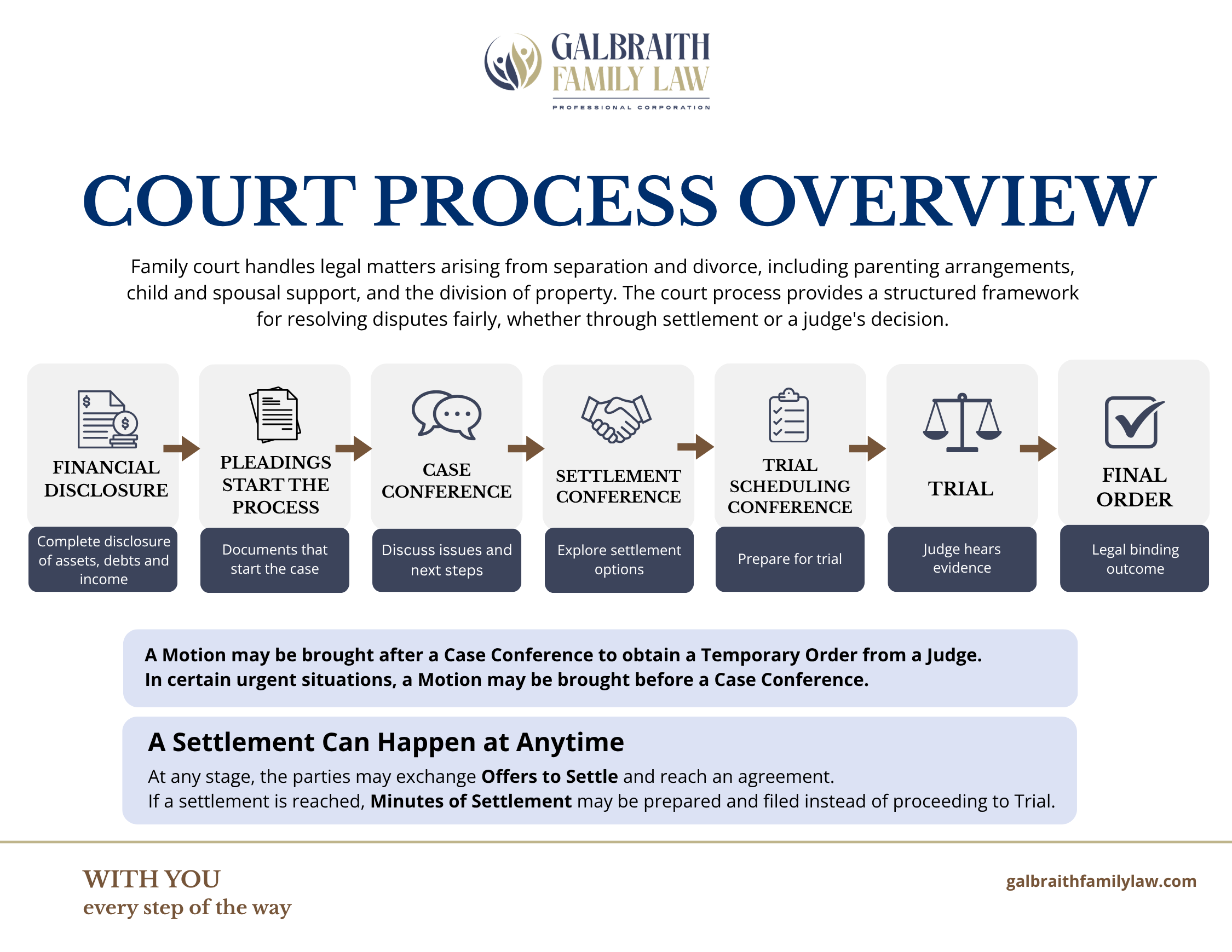
Family court handles legal matters arising from separation and divorce, including parenting arrangements, child support, spousal support, and the division of property. The court process provides a structured framework for resolving disputes fairly, whether through settlement or a judge's decision.
While every case is unique, most family court matters follow a similar path. Our team is here to guide you through each step and help you understand what to expect along the way.
Building a Complete Financial Picture
Before meaningful discussions can take place, both parties are generally required to exchange financial information.
This process may include disclosing:
Income information
Assets and property
Debts and liabilities
Business interests
Financial statements and supporting documents
Complete and accurate disclosure helps ensure informed decisions can be made throughout the court process.
Commencing a Court Application
Pleadings are the court documents used to start a family law case and outline the issues to be addressed by the court.
These documents may identify matters such as:
Parenting arrangements
Child support
Spousal support
Property division
Divorce claims
Once the necessary documents are filed and served, the court process formally begins.
Discussing Issues and Next Steps
A Case Conference is usually the first appearance before a judge. The purpose is to identify the issues in dispute, discuss possible resolutions, and determine the next steps in the case.
At this stage, the court may:
Review the progress of disclosure
Clarify issues between the parties
Encourage settlement discussions
Establish timelines for moving the case forward
Many matters begin moving toward resolution during or shortly after a Case Conference.
Exploring Settlement Opportunities
Settlement Conferences are designed to help parties resolve as many issues as possible without proceeding to trial.
During this stage:
Settlement options are explored
Outstanding issues are identified
Strengths and weaknesses of each position may be discussed
Parties are encouraged to reach practical resolutions
Resolving issues through settlement often saves significant time, stress, and expense.
Preparing for Trial
If important issues remain unresolved, the court may schedule a Trial Scheduling Conference. This step focuses on preparing the matter for trial and ensuring both parties are ready to proceed.
The court may address:
Trial readiness
Witness requirements
Estimated trial length
Outstanding procedural matters
Presenting Evidence Before a Judge
If a settlement cannot be reached, the matter may proceed to trial. During a trial, both parties have the opportunity to present evidence and explain their position to the judge.
The judge will consider:
Testimony and evidence
Applicable legislation
Legal principles
The facts of the case
After hearing the evidence, the judge will make a decision on the issues before the court.
A Legally Binding Outcome
At the conclusion of the court process, the judge may issue a Final Order that sets out the legally binding terms of the decision.
A Final Order can address matters such as:
Parenting and decision-making responsibility
Parenting time
Child support
Spousal support
Property division
Other outstanding family law issues
Both parties are required to comply with the terms of the order.
Addressing Urgent or Interim Issues
In some situations, a Motion may be brought to ask the court for a Temporary Order. These orders can help address important issues while the case is ongoing.
Generally, a Motion may be brought after a Case Conference. However, in certain urgent situations, a Motion may be brought earlier.
One of the most important things to understand about the family court process is that settlement discussions can occur at any stage. Parties may exchange Offers to Settle and reach an agreement without proceeding all the way to trial.
If a settlement is reached, Minutes of Settlement may be prepared and filed, allowing the matter to be resolved without the need for a trial.
To move forward, book a consultation. Prepare by reviewing resources on our website and writing down your questions. We aim to remove uncertainty and give you a clear path ahead.
124 Dunlop Street West
Barrie, ON L4N 1B1
(705) 727-4242
1195 Stellar Drive, Unit 4
Newmarket, ON L3Y 7B8
(289) 319-0634
209 Speers Road, Unit 13
Oakville, ON L6K 0H5
(905) 291-6634
110 James Street, Unit 105
St. Catharines, ON L2R 7E8
(905) 291-5231
© 1993–2026 Galbraith Family Law Professional Corporation · All Rights Reserved
© 1993–2026 Galbraith Family Law Professional Corporation
All Rights Reserved
We use cookies to improve your experience on our website. To learn more, read our privacy policy.